A believable finished photo is not just about the room. It is about whether the room belongs in the city your audience thinks you are in. A perfectly rendered Mediterranean cafe is a great photo, and an unconvincing photo if your audience knows you were in Helsinki.
This article is about geographic consistency: how to pick a setting that fits your story so well that nobody pauses to wonder.
The three layers of geography
When somebody looks at a photo of you in an unfamiliar place, their brain checks, very quickly and mostly unconsciously, three things.
- Macro — does this look like the country I think you are in.
- Meso — does this look like the kind of place you would be in within that country.
- Micro — do the small details (signage, plug sockets, light switches, building materials) match.
Most generated photos pass the macro check, fail the meso check, and never reach the micro check. The interesting result is that the meso check is the one that does most of the damage.
The macro layer: country-level signals
The macro layer is set by a few large, low-resolution cues: building materials, plant life, road furniture, sky colour.
Some signals are very reliable:
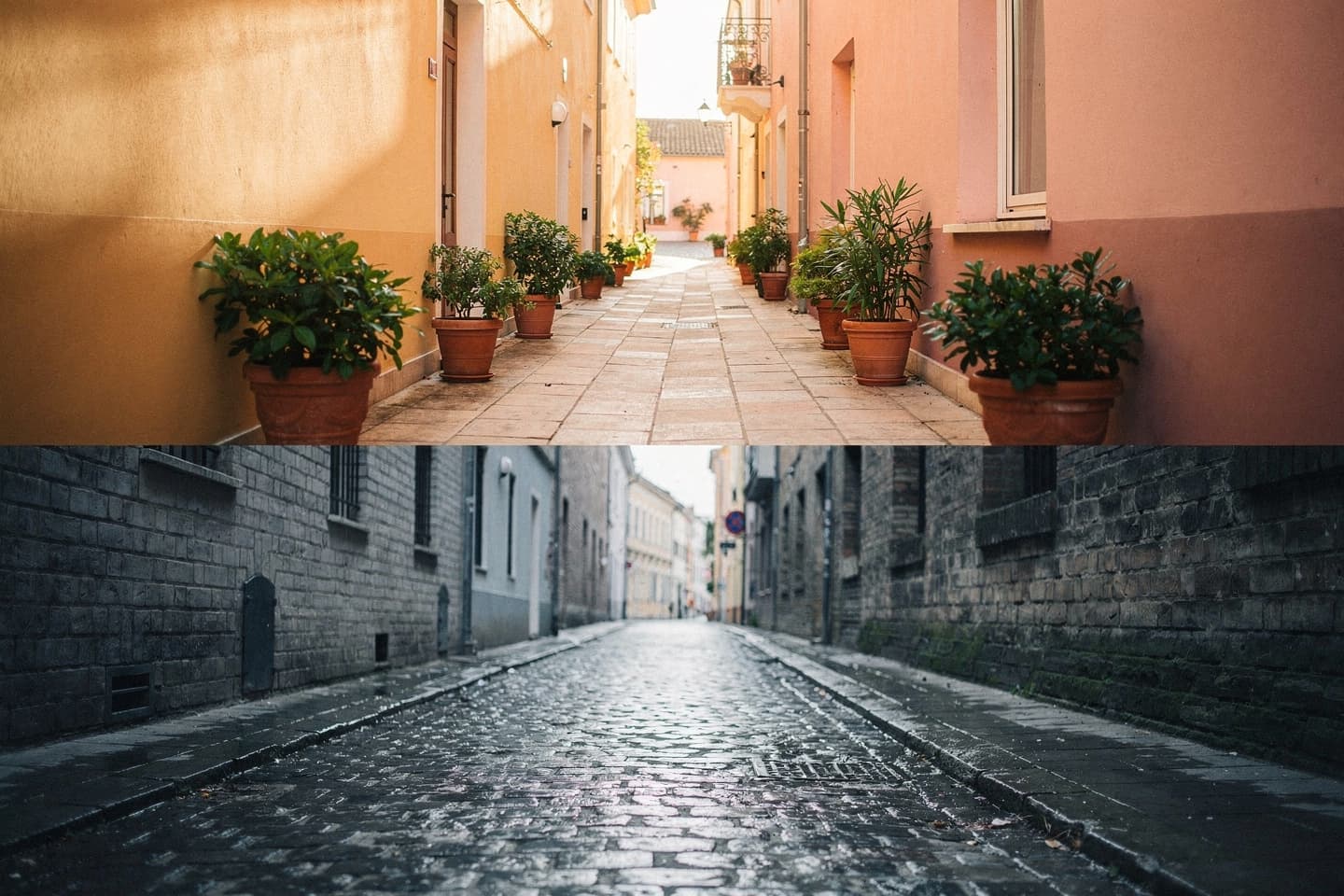
- Pastel stucco + terracotta roofs + bougainvillea → Southern Europe or coastal North Africa.
- Grey or red brick + tram wires + bare deciduous trees in winter → Central or Northern European city.
- Wood-frame buildings + power lines + low overcast light → Pacific Northwest or northern Japan.
- Whitewashed walls + flat roofs + intense overhead light → Mediterranean islands or coastal Levant.
You can pick the macro layer in your prompt with one or two adjectives — southern European, Scandinavian, Mediterranean, Nordic, coastal, alpine. Avoid naming a specific country if possible. The model produces southern European cafe better than Italian cafe, which it produces better than Roman cafe, which it produces better than cafe near the Pantheon. The more specific you get, the more the model has to invent, and the more it fails.
The meso layer: the kind-of-place check
The meso layer is where most finished photos lose plausibility. The macro is right (this looks like Italy) but the type of place is wrong (this looks like a Tuscan farmhouse interior, and your audience knows you went to a beach town).
Two practical rules.
Match the place type to the trip type
A weekend city break does not produce farmhouse photos. A countryside retreat does not produce skyline photos. A business trip does not produce sunset-on-the-pier photos. When you pick the setting, ask: would the trip the audience thinks I am on have included a place like this?
If you do not know what the audience thinks you are doing, you are missing a step. We covered this in Looking Busy at Work While You're on Vacation: an audience always has a hypothesis about where you are, even if they have not stated it.
Match the time of week to the place type
A workday Tuesday in a tourist-only restaurant looks wrong. A Saturday evening in an empty office looks wrong. A Sunday brunch in a closed cafe is a contradiction. Time and place are paired in the audience's mind; mismatching them produces the something is off feeling without anyone knowing why.
The micro layer: details that betray
The micro layer comes up only if somebody looks closely. When they do, these are the details that betray a wrong location:
- Plug sockets in the background. Different shapes by region. Most models render a generic socket that does not match anywhere precisely.
- Light switches. Europe and the US use visibly different ones.
- Window frames. European windows often open inward; American ones often slide vertically. Visible window mechanisms can give the geography away.
- Outlets on cafe walls. The number, position, and shape of available outlets are weirdly diagnostic.
- Foreign-language signage. The model cannot reliably produce readable text in any language. A wrongly-spelled menu or street sign is one of the easiest tells.
The cheapest defence against micro-layer mistakes is the same one we recommended for Office Backgrounds That Don't Look Generated: do not put anything text-shaped in the prompt. No menus, no street signs, no posters, no whiteboards with writing, no neon signs.
A picking framework
When you sit down to generate, run this short checklist before writing the prompt.
- Where does my audience think I am, geographically? Country or region is enough.
- What kind of place would I be in there? A cafe, a hotel lobby, an office, a street.
- What time of day, on what day of the week, would make that place-type plausible?
- Which Tier A setting from The Best Travel Settings to Use in a Prompt fits all three?
- *Which one or two macro adjectives (e.g. southern European, Scandinavian) describe the country without naming it?*
If you can answer all five before you start writing, your prompt almost writes itself, and the result is much harder to second-guess.
A short example, end to end
Audience thinks you are in northern Italy for a long weekend. It is Saturday afternoon. You want a maintenance photo.
- Macro: southern European, late summer light.
- Meso: a small neighbourhood cafe, not a tourist landmark.
- Micro: no signage, no menus, no posters.
Prompt:
A window seat in a small neighbourhood cafe in a southern European town, late Saturday afternoon, soft warm side light from the left, pastel walls, a marble round table with a cappuccino and a closed paperback book, a stone-paved street with a few parked bicycles visible through the window two metres behind me, calm, quiet street, no signage.
The prompt now matches the audience's mental model of where you are, the type of place a weekend visitor would actually sit in, and avoids the text trap. The chance of a viewer pausing is very low.
Related reading
- The Best Travel Settings to Use in a Prompt
- Anatomy of a Perfect Prompt
- Why Timestamps on Photos Matter
- Looking Busy at Work While You're on Vacation
Try it yourself
Three free credits at btdt.fun. Pick the macro layer first, then the meso, then write the prompt — and see how much it changes the result.