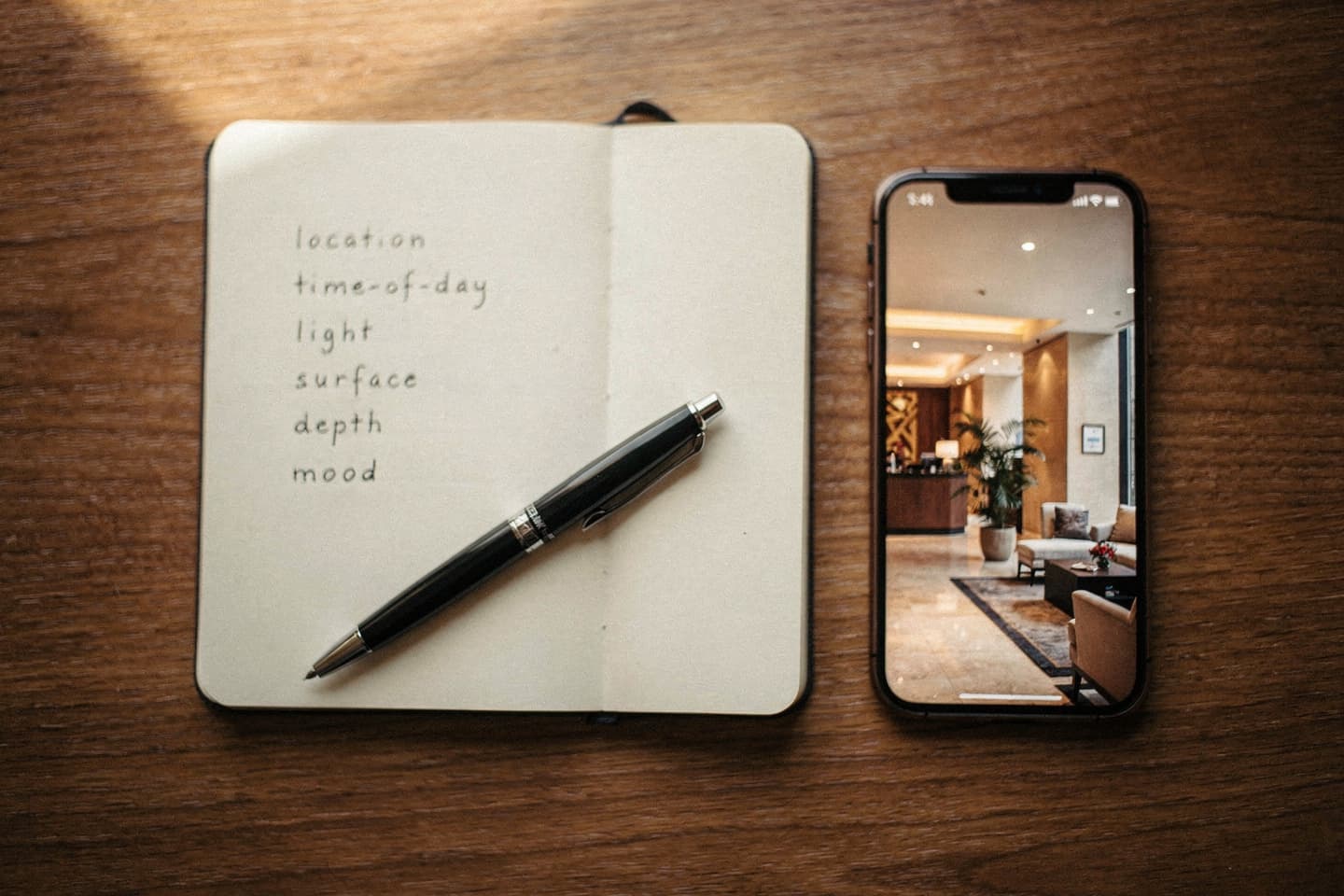
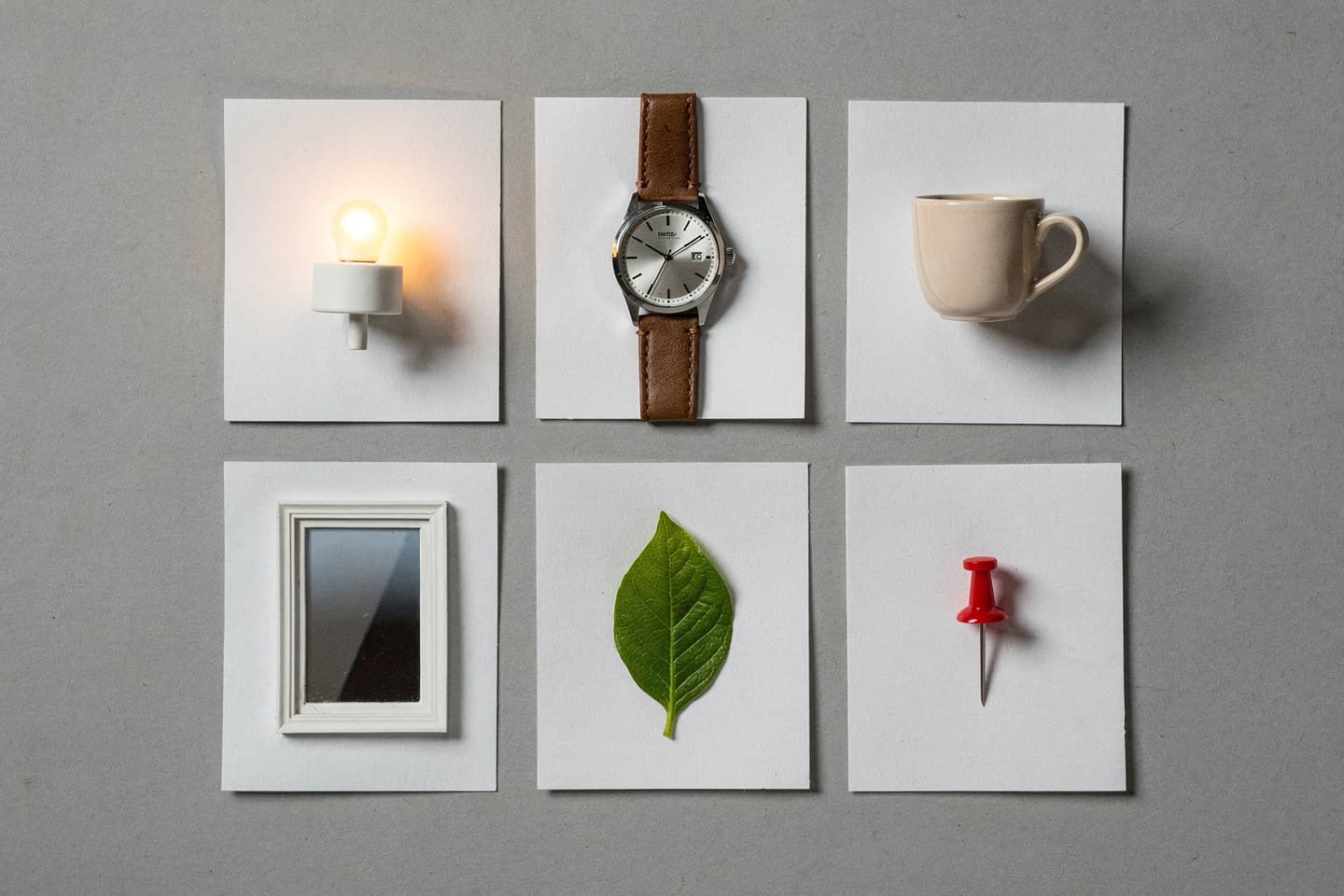
A good prompt is not a paragraph. It is six ingredients, in any order, in plain language. The app does the rest.
This guide gives you the six ingredients, the common mistakes that ruin a result, and worked examples for the most-requested settings: a cafe, a hotel lobby, an airport, and an office desk.
The six ingredients
Every realistic finished photo answers six questions about the scene. If your prompt answers all six, the model has enough to work with. If it answers three, you are gambling on what the model fills in by default.
- Place — where the scene is happening. A hotel lobby. A window seat in a cafe. An airport gate.
- Time of day — morning, midday, late afternoon, evening, night. This drives the light more than any other word.
- Light source — natural window light, warm overhead lamps, evening street light, screen glow. You can combine them.
- Surface in front of you — a wooden table, a marble counter, a low coffee table, a desk with a laptop. Surfaces sell the realism more than the background.
- Depth — what is behind you and how far away it is. A bookshelf two metres behind. A floor-to-ceiling window with the street visible. A long corridor receding.
- Mood — quiet, busy, late, hurried, calm. One word is enough. This nudges the model toward the right number of background figures and the right amount of motion blur.
That is the whole framework. The shorter version: place, time, light, surface, depth, mood.
The single most common mistake
People write prompts about themselves. They describe their pose, their expression, their outfit. The model already has the selfie. It knows what you look like. Words you spend on yourself are words you are not spending on the setting.
A useful rule: describe the room, not the person.
The second most common mistake
Overloading the prompt with brand names, exact addresses, or recognisable landmarks. The model is better at the feeling of a Scandinavian hotel lobby than at the lobby of the Hotel Esplanade in Zagreb. Specific landmarks tend to come out as approximations of themselves, which reads as fake. Generic-but-specific reads as real.
A useful rule: be specific about the kind of place, not about the place.
Worked examples
A cafe window seat, mid-afternoon
A window seat in a small neighbourhood cafe, mid-afternoon, soft natural light from the left, a small marble round table with a half-finished cappuccino and a closed book, a quiet street with parked bicycles visible through the window two metres behind me, calm.
All six ingredients are present. The model knows where to put the light, what surface to render in the foreground, and how busy to make the background.
A hotel lobby, evening
A boutique hotel lobby in the early evening, warm overhead lamps and one tall floor lamp, a low velvet armchair facing a dark wooden coffee table, a reception desk receding into the background about six metres behind me, calm, almost empty.
This prompt fixes the most common hotel-lobby failure: the model invents a crowded reception. Almost empty solves it in two words.
An airport gate, late evening
An airport gate area late in the evening, large floor-to-ceiling window behind me with the apron and a parked aircraft visible, fluorescent overhead light mixed with the warmer light of a nearby cafe sign, a black metal armrest in the foreground, a few seated travellers further down the row, quiet, almost departure-time.
The mix of two light sources is what makes airports look airport-like. One light source flattens the scene.
A home office desk, morning
A home office desk by a window, mid-morning, cool natural light from the right, a wooden desk surface with a laptop, a small ceramic cup, a notebook, a plant in a terracotta pot just beyond the laptop, a bookshelf about a metre and a half behind, calm.
Notice that the laptop, cup, and notebook are in front of you, not behind. Foreground objects are what make a desk shot feel like a real working session.
Things to leave out
- Your own clothes, age, or face. The selfie handles that.
- Adjectives stacked on adjectives (beautiful golden warm cosy soft cinematic). Pick one mood word. The model will translate.
- Camera settings (shot on 35mm, f/1.8, bokeh). The app already targets photo realism. Camera language nudges it toward stylised AI imagery, which is the opposite of what you want.
- Brand names, except generically (coffee shop, not Starbucks).
A small checklist before you tap generate
- Did I name the place?
- Did I name the time of day?
- Did I name a light source?
- Did I name a surface in front of me?
- Did I name what is behind me, and how far?
- Did I give one word of mood?
If you can tick all six, your prompt is in the top 10 per cent of prompts the app receives.
Related reading
- How to Describe a Setting in 10 Words
- The Best Travel Settings to Use in a Prompt
- Office Backgrounds That Don't Look Generated
- Lighting Tips for Believable Composite Photos
Try it yourself
Build a six-ingredient prompt and run it free at btdt.fun. Three credits, no subscription, no card on file.