Not all travel locations are equally easy to produce well. Some prompts almost always succeed; others are a coin flip; a few never quite work and we recommend avoiding them. This is a ranked field guide.
The criteria for the rankings: how often the result is believable on the first generation, how forgiving the setting is to small prompt-and-selfie mismatches, and how likely it is to draw a that doesn't look right response from a viewer.
Tier A: Almost always works
These settings have generic visual vocabularies, soft consistent lighting, and few specific architectural landmarks. The model has seen thousands of them and tends to converge on a believable average.
A hotel lobby
A boutique hotel lobby in the early evening, warm overhead lamps, a low velvet armchair, a long dark wooden coffee table, a reception desk receding into the background, calm, nearly empty.
Why it works: hotel lobbies have low contrast lighting, low specific detail, and predictable furniture. Avoid naming a hotel by name. Add the word boutique or small to avoid the model rendering a chain lobby with too much branding.
A cafe window seat
A window seat in a small neighbourhood cafe, mid-afternoon, soft natural light from the left, marble round table with a cappuccino and a closed book, parked bicycles visible through the window two metres behind me, calm.
Why it works: cafe interiors are forgiving of small lighting mismatches, and the window gives the model an excuse to soften the face-light gradient.
An airport gate or lounge
Airport gate area, late evening, large floor-to-ceiling window behind me with a parked aircraft visible, fluorescent overhead light mixed with the warmer light of a nearby cafe sign, a black metal armrest in the foreground, a few seated travellers further down the row, almost departure time.
Why it works: airports have very consistent visual vocabularies world-wide. Add two light sources for realism (fluorescent + a warmer accent).
A train window
A train window seat, early morning, low warm sunlight from the right, a small folding table with a paper coffee cup, a closed laptop, a notebook with a pen across it, the inside of the train car receding behind me, calm.
Why it works: train interiors are even more generic than airports. Almost any first-class or intercity carriage works. Avoid naming a specific line.
Tier B: Works with care
These work most of the time, but they are sensitive to selfie quality and prompt detail. Read them as good options if you have followed the source-photo guide.
A cobbled European street
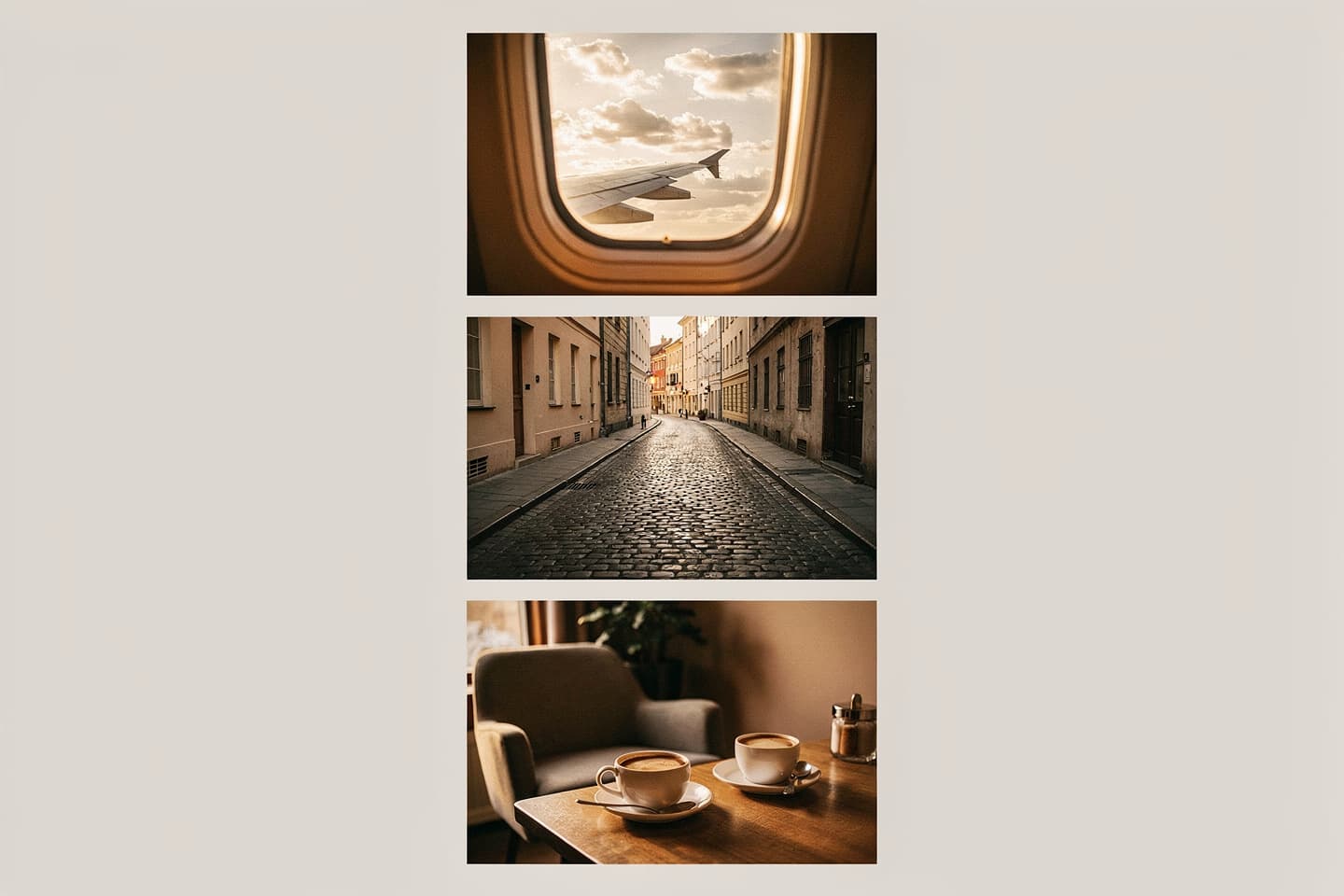
A narrow cobbled side street in an old European city, late afternoon, low warm light from the right, pastel facades, a single closed shutter visible to my left, no traffic, two people walking away from me in the distance, quiet.
Watch for: the model often invents recognisable landmarks if you do not constrain it. Keep the description residential and side-street. Avoid naming the city.
A hotel balcony
A small hotel balcony in the late afternoon, warm sunlight, a wrought-iron railing in the foreground, white-stuccoed building facades and tiled roofs visible below, a single small round table with a coffee cup, calm, no breeze.
Watch for: balconies need a foreground (the railing, a table) or they read as floating. The wrought-iron railing is the single most useful detail.
A restaurant table in the evening
An evening dinner table at a quiet restaurant, warm overhead pendant light, a marble table with two glasses of red wine, a small candle, a soft-focus diner at the next table about three metres behind me, calm, low murmur.
Watch for: the model tends to over-decorate restaurants. Keep the table description sparse. Two glasses signals company without forcing the model to render a face.
A beach path
A wooden boardwalk path through dune grass towards a beach, late afternoon, warm side light from the right, soft shadows, no umbrellas, the sea just visible at the end of the path, calm, almost empty.
Watch for: full beaches are hard (people, umbrellas, expressions). A boardwalk toward the beach is much easier than the beach itself.
Tier C: Coin flip
These are recognisable enough that small mistakes are obvious.
A ski slope
The model knows what skiing looks like, but the specific physics of light on snow rarely match the typical selfie light. The face often looks too soft for the brightness around it. If you must, take the selfie in a brightly daylit, neutral-walled room.
A festival or concert crowd
Crowds with faces are the hardest thing the model does. The faces in the background often look wrong, and wrong faces are the easiest thing for a viewer to notice. If you want a concert vibe, prompt for the venue from the back (the back of a small concert venue, stage lights visible in the distance).
Inside a famous museum
Specific famous artworks rarely render well. A generic quiet museum corridor with framed paintings on a dark wall is much more reliable than standing in front of the Mona Lisa.
Tier D: Rarely works — recommend against
These are the prompts we suggest avoiding.
- Specific landmarks (Eiffel Tower, Times Square, Colosseum). The model produces approximations of these from training data, and they almost always look slightly wrong to viewers who have actually been there.
- Underwater scenes. Refraction is hard. The face-light gradient never matches.
- Active sports. Anything with motion blur tends to produce a face that does not match the rest of the body's blur.
- Driver's seat of a car. Window reflections on glasses, on the windshield, and on the dashboard all have to agree. They rarely do.
The honest framing: if your goal is a believable finished photo, pick a Tier A setting and spend your prompt budget on light, surface, and depth. Pick a Tier D setting only if you accept that the result is going to look composed.
A short closing rule
The single biggest predictor of success is the answer to this question:
Could a real friend have taken this photo of me at this place, with this composition, in 30 seconds, without making me pose?
If yes, the model can usually produce it. If no, you are asking the model to do something it was not built for.
Related reading
- Anatomy of a Perfect Prompt
- Plausible Geography: Picking Locations That Match Your Story
- How to Describe a Setting in 10 Words
Try it yourself
Pick a Tier A setting and try one free at btdt.fun. Three credits, no card on file.