
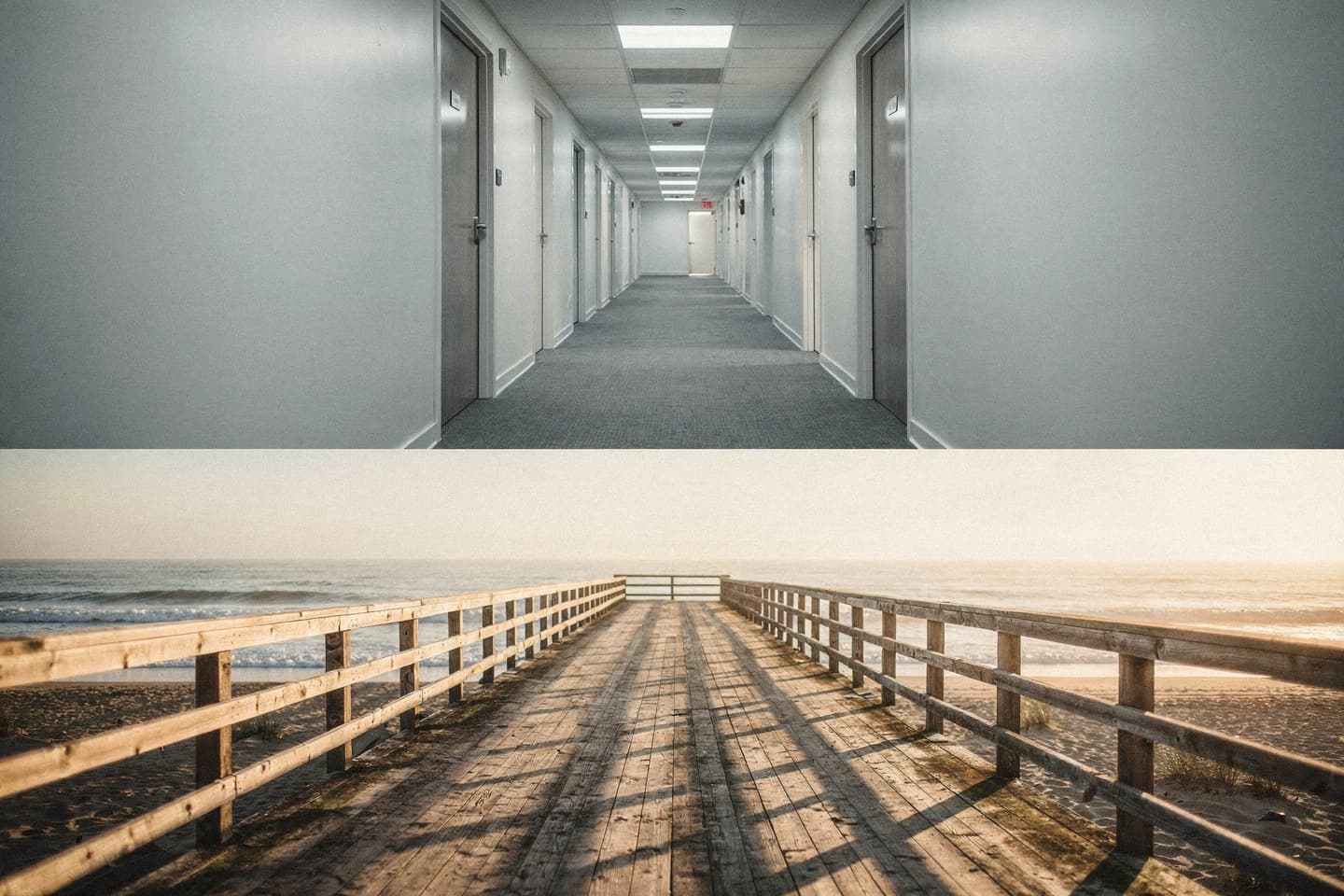
The most common reason people open this app is not what most articles about AI assume. It is not vanity. It is not deception. It is the quiet, daily mismatch between the life I am actually living and the life my feed implies I am living. We call this the boring job problem, and it is a structural problem, not a personal failing.
What the problem actually is
Most adults spend the majority of their waking hours doing something that does not photograph well. A spreadsheet open in front of a fluorescent overhead. A long video call in a quiet kitchen. A commute. A waiting room. A school run. None of these things are bad. They simply do not produce images that resemble the images the rest of the internet seems to be made of.
Meanwhile, the feeds we scroll through are an aggregate of the best 1 per cent of everyone else's week. Cafes, beaches, dinners, concerts, hikes. By volume, the internet looks like it is permanently on holiday.
The maths is unforgiving. If 100 of your friends each have one genuinely interesting moment per week, your feed will show you 100 genuinely interesting moments per week. Your own week has, on average, one. You are competing against a number that is not real.
Why this hurts people
If the gap were only about envy, it would be a small problem. It is not. It compounds in three ways.
- Self-image — daily exposure to a curated average makes you grade your own ordinary days against it. The verdict is always worse, because the comparison is rigged.
- Social standing — people in your network slowly form a model of you out of what you post. If you post nothing, you become invisible. If you post your ordinary days as they are, you can feel exposed.
- Decisions — people quit jobs, move cities, end relationships, and spend money they do not have because the alternative — staying ordinary — has been quietly reframed as failure.
None of these are personal weaknesses. They are predictable side effects of a media environment that was not designed with anyone's mental health in mind.
The three things people try
People deal with the boring job problem in roughly three ways.
Try harder
The first reflex is to make the ordinary days look more interesting. Better camera angles, better cafes, better lighting, better captions. This works for a while, then stops, because the underlying maths has not changed. You are still one person trying to match the highlight reel of 100.
Withdraw
The second reflex is to stop posting. This works for some people. For others, the silence becomes its own problem — are you okay, are we still friends, did something happen — and after a few weeks they come back. We covered the structured version of this in Quiet Quitting Your Social Media.
Selectively curate
The third reflex, and the one this app was built for, is to keep posting at a normal cadence, but to make the cadence sustainable. That can mean posting older photos. It can mean posting photos that were never going to be photographed in the first place — the cafe you would have liked to be in, the hotel lobby you walked through last month, the view from the seat you wished you were in.
We are not pretending this is heroic. We are saying it is one of the gentler answers to a problem that has no clean solution.
Why a finished photo helps
A finished photo from this app costs you about a minute of attention. In exchange, your feed gets one more entry that resembles everyone else's feed. The cost is small. The cumulative effect — over weeks — is that the conversation between your week and the internet's week becomes less hostile to your own self-image.
This is the least dramatic possible defence of the product. We think it is also the most honest one.
Where this stops being a good idea
If you find yourself building an entirely fictional life out of finished photos, the tool has crossed from cope into replacement. The signal that this has happened is usually internal: you are no longer relieved by the published photo, you are anxious about whether it will be believed.
When that happens, the answer is not better prompts. The answer is to publish less for a while, and to spend the recovered time on the actual life the photos are supposed to be representing.
We laid this out more carefully in The Authentic Self vs the Performed Self.
The honest closing point
The boring job problem will not be solved by any app, including ours. It will be solved, slowly, by a generation of people deciding that the highlight-reel internet is not a reasonable yardstick for an ordinary life. Until then, a finished photo every few days is one of the kinder workarounds available.
Related reading
- The Psychology of FOMO and How to Stop Feeding It
- Quiet Quitting Your Social Media
- Looking Busy at Work While You're on Vacation
- The Authentic Self vs the Performed Self
Try it yourself
Three free credits at btdt.fun if the gap between your week and your feed is starting to bother you.