
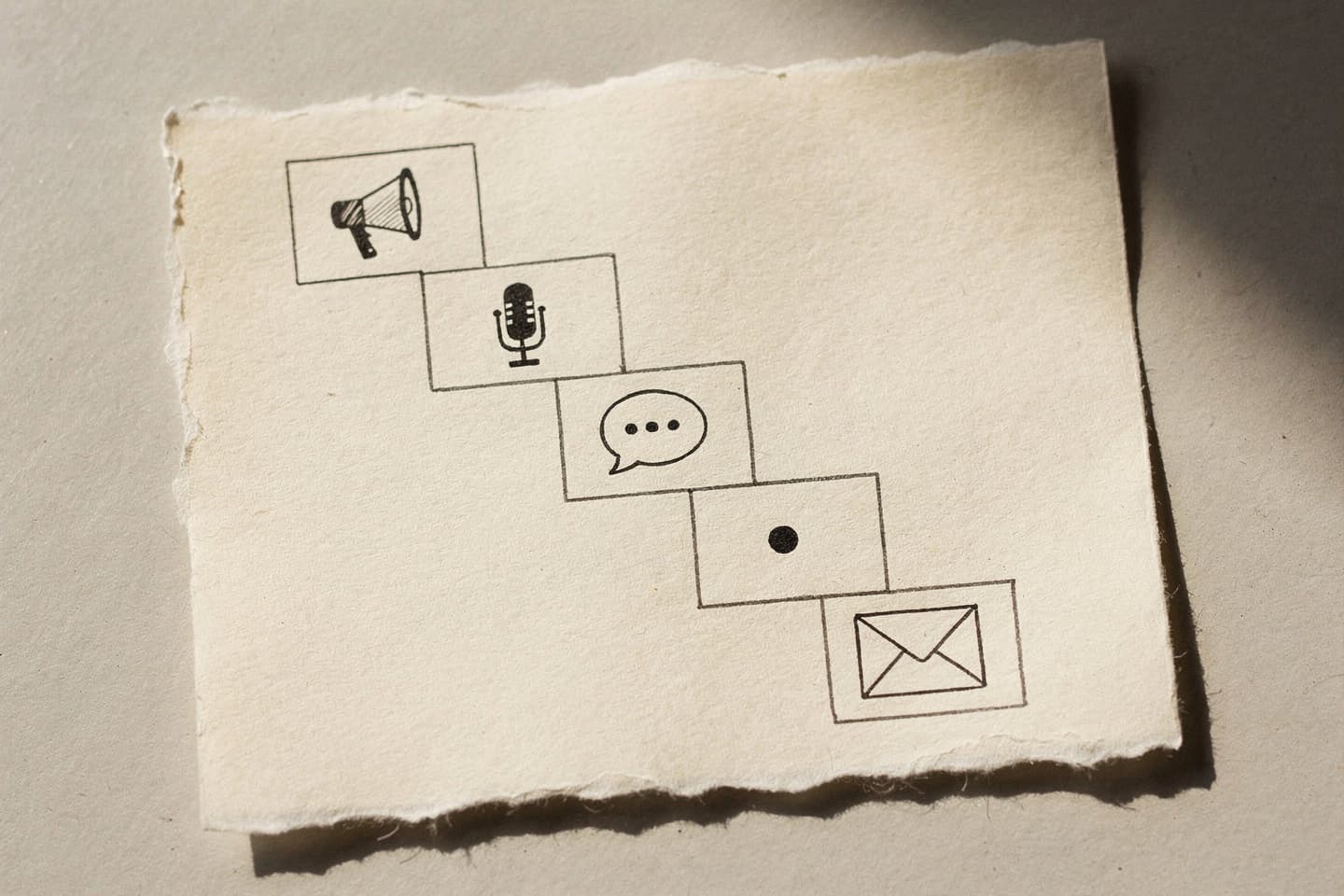
You do not have to delete your accounts. You do not have to declare a digital detox. You do not have to write a goodbye post. There is a middle path between posting every day and vanishing, and most of the people on it never announced they were doing it. This is a practical guide to that path.
What quiet quitting actually means here
Borrowed from the workplace usage, quiet quitting in a social-media context means three things, in order:
- Doing the minimum that keeps your social ties intact.
- Refusing to do more than that, even when the platform's design pushes you to.
- Not making it a public statement.
It is not the same as deactivating. Deactivation is a clear signal. Quiet quitting is a gradient: you keep showing up, but on your terms, on your schedule, with content you can sustain.
The trap most people fall into when they try this is binary thinking. Either they post like before, or they go silent for three weeks and then come back with a long explanation. The middle position — visible, but boring, on purpose — is the one that lasts.
The five-step staircase
A practical version of quiet quitting looks like a staircase. Each step reduces your output without breaking the social fabric.
Step 1: Stop posting in real time
The single highest-cost habit in modern social media is posting things while they are happening. It splits your attention, it floods your followers with too much from one source, and it sets an expectation that you will always be reachable in this way.
Replace it with a 24- to 72-hour delay. Anything you wanted to post live, post tomorrow instead. After a week, nobody will notice. After a month, neither will you.
Step 2: Cut the frequency in half
Look at your last 30 days. Count your posts. Aim for half of that next month. Not zero, not the same. Half.
This is the single most effective change most people can make. It preserves your visibility (the platform's algorithm cares more about recent than frequent) while halving the time and emotional cost.
Step 3: Replace one real post a week with a maintenance post
Most weeks contain a few photographable moments and a lot of moments that are not. The trap is that when the photographable moments run out, people either over-post the ones they have, or go silent.
A better approach is to allow yourself one maintenance post per week: a photo that exists to keep the cadence going, not to share an event. A coffee, a window seat, a walk. This is exactly where a finished photo from this app fits — it lets you maintain the cadence on a week where the real material is thin.
We are not telling you the maintenance post has to be a finished one. We are saying that something has to fill the gap, and a finished photo is one of the cheaper, less stressful options.
Step 4: Move private things into private channels
A lot of what gets posted publicly is meant for two people. A photo for your partner. A meme for one friend. A complaint that one specific person needs to see. Move all of that out of the feed and into direct messages.
This step alone usually reduces public posting by another 30 per cent, and almost nobody misses the moved content.
Step 5: Stop reading the metrics
The last step is the hardest. Stop checking likes, comments, and view counts. Not forever — for two weeks. Most people find that when they stop measuring, the urge to post drops further on its own.
The role of finished photos
A finished photo is not a content strategy. It is a tool for the moments in the staircase above where the alternative is posting nothing. Used that way, it is the equivalent of a placeholder slide in a meeting: it keeps the show going so you can think about what you actually want to say next.
If you find yourself relying on finished photos for every maintenance post, the staircase is doing its job — your feed is now small enough that even one missed week feels like a long absence. The cure is not more finished photos. The cure is to lower the cadence by another notch.
This is the same principle we discussed in The Boring Job Problem: the tool helps you survive a structural mismatch, not pretend it does not exist.
What to do when people notice
Some people will notice you are posting less. A few will ask. The script that works in almost every situation is two sentences long:
Yes, I'm posting less on purpose. It's been good for me.
Do not justify it. Do not promise a return date. Do not turn it into a manifesto. The next time you do post, the person will either be relieved or move on. Both are fine.
When to skip the staircase entirely
If your social-media presence is contractually required — you are a creator, a small-business owner, a public-facing employee — the staircase needs to be adapted. The core idea is the same: reduce real-time, halve frequency, allow maintenance posts, move private content to private channels. The metric will be different. The posture is identical.
A short closing point
Quiet quitting is not a victory over social media. It is a truce. You agree to keep showing up. The platform agrees to take less of you in return. The truce holds because you do not make it a public fight.
Related reading
- The Boring Job Problem
- The Psychology of FOMO and How to Stop Feeding It
- The Authentic Self vs the Performed Self
Try it yourself
If you want to test the maintenance-post idea with a single finished photo before changing anything else, try it free at btdt.fun. Three credits, no subscription, no card on file.